
Authored by the expert who managed and guided the team behind the Algeria Property Pack
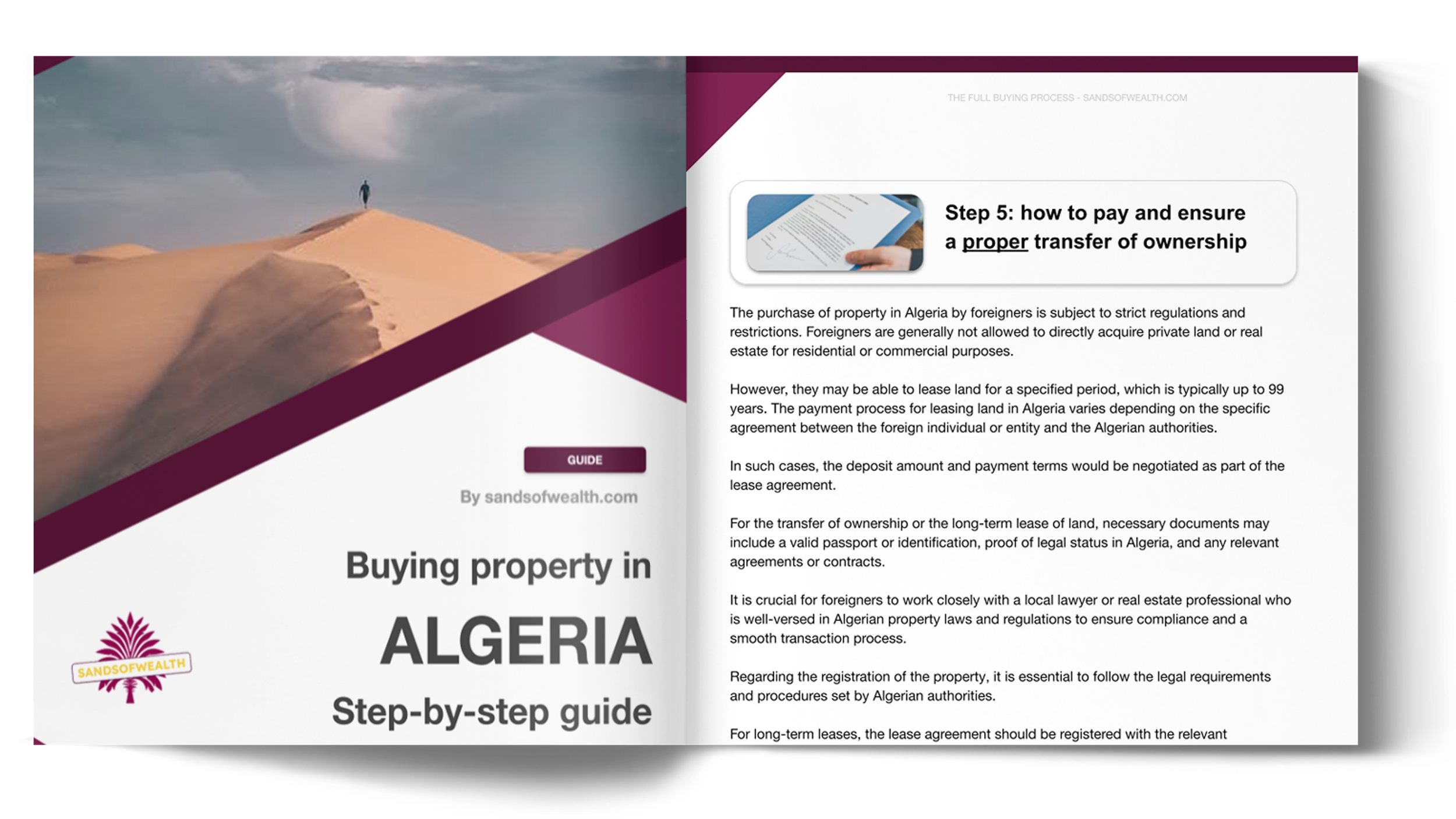
Everything you need to know before buying real estate is included in our Algeria Property Pack
Moving to Algeria and purchasing property as a foreigner involves navigating a complex bureaucratic system that requires government approval, extensive documentation, and local expertise. The process typically takes 3-6 months and involves multiple administrative steps that are significantly more restrictive than property purchases in Western countries.
If you want to go deeper, you can check our pack of documents related to the real estate market in Algeria, based on reliable facts and data, not opinions or rumors.
Buying property in Algeria as a foreigner requires government approval, local bank account setup, and extensive documentation verification, with the entire process taking 3-6 months on average.
Total costs including taxes, fees, and administrative expenses typically range from 3.67% to 9.51% of the property's value, while mortgage financing remains extremely limited for foreign buyers.
| Process Step | Time Required | Key Requirements |
|---|---|---|
| Initial Setup (Visa, Bank Account) | 2-4 weeks | Valid passport, visa application, proof of income |
| Property Search & Selection | 2-8 weeks | Licensed agent, lawyer consultation, due diligence |
| Legal Documentation | 3-4 weeks | Title deed verification, notarized purchase agreement |
| Government Approval | 4-8 weeks | All mandatory documents, tax payments |
| Final Registration | 1-2 weeks | Property office registration, final fee payments |
| Property Transfer | 1 week | Keys handover, utility transfers |
| Total Timeline | 3-6 months | Complete documentation package |

How easy is it compared to moving and buying property in Western countries?
Buying property in Algeria as a foreigner is significantly more challenging than purchasing real estate in Western countries like France, Germany, or the United States.
The Algerian property acquisition process requires government approval at multiple stages, extensive document verification, and compliance with foreign investment regulations that don't exist in most Western markets. As of September 2025, foreign buyers must navigate bureaucratic procedures that can take 3-6 months compared to 4-8 weeks in countries like Spain or Portugal.
Western countries typically offer streamlined online systems, standardized legal procedures, and transparent property registries that make the buying process predictable. Algeria's system relies heavily on paper documentation, in-person verification, and administrative approval processes that can create delays and uncertainty for international buyers.
The language barrier adds another layer of complexity, as most official documents and legal proceedings are conducted in Arabic or French, requiring professional translation services for buyers who don't speak these languages fluently.
It's something we develop in our Algeria property pack.
What are the exact steps to move to Algeria and purchase a property?
The property acquisition process in Algeria follows a structured sequence that begins with establishing legal residency and concludes with property registration.
Step 1: Obtain the appropriate visa for your intended stay duration - tourist visas allow property viewing but long-term residence permits are necessary for actual purchases. Employment visas or business investment visas provide the strongest foundation for property acquisition.
Step 2: Open a local bank account with one of Algeria's major banks such as Banque d'Algérie or Crédit Populaire d'Algérie, which requires your passport, visa documentation, and proof of income. Simultaneously apply for a Tax Identification Number (NIF) from the local tax office.
Step 3: Engage a licensed real estate agent and qualified property lawyer to identify suitable properties and conduct preliminary legal checks. This stage involves visiting multiple properties and understanding local market conditions in your target area.
Step 4: Conduct comprehensive due diligence including title verification, property condition assessment, and neighborhood analysis. Your lawyer should verify the seller's ownership rights and check for any liens or legal disputes affecting the property.
Step 5: Negotiate terms and sign a preliminary purchase agreement (compromis de vente) that includes price, payment schedule, and completion timeline. This document must be notarized by an official notary public.
Step 6: Submit your complete application package to the relevant government authorities for foreign investment approval, including all supporting documentation and fee payments.
Step 7: Upon receiving government approval, complete the final purchase agreement, transfer funds through your Algerian bank account, and register the property at the local property office (Conservation Foncière).
Which documents are mandatory and which ones are optional?
Document requirements for foreign property buyers in Algeria are extensive and divided into absolutely mandatory items versus situational requirements.
| Document Type | Status | Purpose |
|---|---|---|
| Valid Passport | Mandatory | Identity verification and legal status confirmation |
| Residence Permit/Visa | Mandatory | Legal right to reside and conduct business in Algeria |
| Bank Statements (6 months) | Mandatory | Proof of financial capacity and income source verification |
| Title Deed (Akte el-Milk) | Mandatory | Official property ownership documentation |
| Notarized Purchase Agreement | Mandatory | Legal contract binding buyer and seller |
| Property Registry Certificate | Mandatory | Confirmation of property registration status |
| Tax Payment Receipts | Mandatory | Evidence of all required tax and fee payments |
| Power of Attorney | Optional | Authorizes representative to act on your behalf |
| Marriage Certificate | Optional | Required only for married individuals in certain provinces |
| Birth Certificate | Optional | Additional identity verification for complex transactions |
All foreign documents must be apostilled or legalized through the Algerian consulate in your home country and translated into Arabic or French by a certified translator. The translation and legalization process typically adds 2-3 weeks to your timeline.
Can the whole process be done without being physically in Algeria?
Complete remote property purchase in Algeria is not feasible due to mandatory in-person requirements at critical stages of the transaction.
While initial research, property selection, and preliminary negotiations can be conducted remotely through video calls and digital communication, several key steps require physical presence or authorized representation. Notarization of the final purchase agreement, bank account opening, and property registration at the Conservation Foncière typically mandate personal appearance.
The most practical approach for international buyers is establishing a power of attorney with a trusted local representative, such as your property lawyer or a family member with Algerian residency. This legal authorization allows your representative to complete transactions on your behalf, but the power of attorney document itself must be prepared and notarized according to both your home country's requirements and Algerian legal standards.
Remote buyers should plan for at least one extended visit to Algeria lasting 2-3 weeks to handle bank account setup, initial property viewings, and relationship building with local professionals. Subsequent visits may be necessary for final contract signing and key handover unless you have established reliable local representation.
Don't lose money on your property in Algeria
100% of people who have lost money there have spent less than 1 hour researching the market. We have reviewed everything there is to know. Grab our guide now.

What types of property can foreigners buy, and what is restricted?
Foreign property ownership in Algeria is permitted for residential and commercial properties but faces significant restrictions in specific categories and geographic areas.
Permitted property types include apartments, houses, villas, and commercial buildings in urban areas such as Algiers, Oran, Constantine, and other major cities. Foreigners can purchase office spaces, retail properties, and mixed-use developments without special restrictions, provided they obtain standard government approval.
Agricultural land remains completely restricted to foreign ownership, as Algeria maintains strict policies protecting agricultural resources for domestic food security. Properties located within 50 kilometers of international borders are also prohibited for foreign buyers due to national security considerations.
Industrial properties present a more complex situation - foreign ownership is possible but typically requires partnership with Algerian nationals or companies, with foreign ownership capped at 49% in most industrial sectors. Manufacturing facilities, warehouses, and production plants fall under these partnership requirements.
Coastal properties face additional scrutiny and may require special permits, particularly for developments within 300 meters of the shoreline. These regulations aim to preserve Algeria's Mediterranean coastline while allowing controlled foreign investment in the tourism sector.
How long does the process usually take from start to finish?
The complete property acquisition timeline in Algeria typically spans 3-6 months from initial property selection to final ownership registration.
The first phase involving visa processing, bank account opening, and initial property research usually takes 4-6 weeks. This includes obtaining the necessary residence permits, establishing financial relationships with Algerian banks, and conducting preliminary property searches with local agents.
Due diligence and legal verification consume 3-4 weeks, during which your lawyer conducts title searches, property condition assessments, and seller verification procedures. This phase is critical for identifying potential legal issues that could complicate the transaction later.
Government approval represents the most unpredictable element, potentially taking 4-8 weeks depending on the complexity of your application and the efficiency of local administrative offices. Applications submitted during government holidays or administrative restructuring periods may experience additional delays.
Final contract execution, payment processing, and property registration typically require 2-3 weeks once government approval is secured. This includes notarization, fund transfers through Algerian banking systems, and completion of property registry updates.
It's something we develop in our Algeria property pack.
What taxes, fees, and extra costs should I expect, with a full breakdown?
Total property acquisition costs in Algeria range from 3.67% to 9.51% of the property's purchase price, depending on the property type, location, and specific services required.
| Cost Category | Percentage of Property Value | Description |
|---|---|---|
| Transfer Tax | 2.5% | Government tax on property ownership transfer |
| Notary Fees | 0.5% - 1.2% | Official document preparation and notarization |
| Registration Fees | 0.4% - 0.6% | Property registry office documentation |
| Real Estate Agent Commission | 2% - 5% | Agent services and property marketing |
| Legal Fees | 1% - 2% | Lawyer services for due diligence and contracts |
| Translation and Certification | 0.2% - 0.3% | Document translation and official certification |
| Bank Transfer Fees | 0.1% - 0.2% | International wire transfer charges |
| Miscellaneous Administrative | 0.2% - 0.5% | Various stamps, certificates, and processing fees |
Additional ongoing costs include annual property taxes ranging from 0.1% to 0.3% of assessed property value, building maintenance fees for apartments (typically 50-150 USD monthly), and utility connection deposits averaging 200-500 USD per service.
Property insurance is not mandatory but highly recommended, costing approximately 0.2% to 0.4% of property value annually. Some buyers also invest in property management services if planning to rent their property, which typically charge 8-12% of monthly rental income.
Can foreigners pay cash, or are there rules around this?
Cash payments for property purchases in Algeria are legally permitted for foreign buyers, but structured bank transfers through official Algerian financial institutions are strongly recommended for legal compliance and transaction security.
Large cash transactions exceeding 500,000 Algerian dinars (approximately 3,700 USD as of September 2025) trigger automatic reporting requirements to Algeria's financial intelligence unit and may delay your transaction while authorities verify the funds' legitimate origin. These reporting mechanisms are designed to prevent money laundering and ensure compliance with international financial regulations.
Bank transfers through your established Algerian bank account provide superior transaction security, create clear documentation for tax purposes, and demonstrate proper fund sourcing to government authorities. Most sellers and notaries prefer bank transfers as they provide irrefutable proof of payment and reduce risks associated with large cash handling.
Foreign currency cash payments are generally prohibited - all transactions must be conducted in Algerian dinars, requiring currency exchange through authorized banks or exchange offices. Attempting to pay in euros, dollars, or other foreign currencies can result in transaction cancellation and legal complications.
Cryptocurrency payments remain illegal for real estate transactions in Algeria, and any attempt to use digital currencies could result in criminal charges and property seizure.

We did some research and made this infographic to help you quickly compare rental yields of the major cities in Algeria versus those in neighboring countries. It provides a clear view of how this country positions itself as a real estate investment destination, which might interest you if you're planning to invest there.
Is mortgage financing available for foreigners, what are the conditions, rates, and tips to get approved?
Mortgage financing for foreign property buyers in Algeria is extremely limited, with only a handful of banks offering loans to non-residents under strict conditions.
Available mortgage options typically require foreign buyers to maintain permanent residency status in Algeria, demonstrate stable local income sources, and provide extensive financial documentation spanning 12-24 months. Interest rates for foreign borrowers range from 6% to 7% annually, significantly higher than rates offered to Algerian nationals (4.5% to 5.5%).
Loan-to-value ratios for foreigners are capped at 60-70%, meaning buyers must provide 30-40% down payments plus transaction costs. Banks also require comprehensive income verification, including employment contracts, tax returns, and bank statements from both your home country and Algeria.
The most practical financing strategies for foreign buyers include:
1. **Securing financing from your home country bank** with the Algerian property as collateral, often providing better rates and terms2. **Partnering with Algerian nationals** who can access domestic financing at favorable rates3. **Establishing significant Algerian banking relationships** through business operations or employment before applying for mortgages4. **Considering developer financing** for new construction projects, which sometimes offers more flexible terms than traditional banks5. **Using bridge financing** to complete the purchase while arranging long-term financing solutionsBanks most likely to consider foreign mortgage applications include Crédit Populaire d'Algérie, Banque Extérieure d'Algérie, and Société Générale Algérie, but approval rates remain low and processing times extend 2-4 months.
Are real estate agents in Algeria generally reliable, and how do you find a trustworthy one?
Real estate agent reliability in Algeria varies significantly, with the industry lacking standardized licensing requirements and professional oversight that exists in Western markets.
Trustworthy agents typically possess formal business licenses, maintain established offices in prime commercial areas, and demonstrate extensive knowledge of local property laws affecting foreign buyers. The most reliable agents often hold memberships in professional associations such as the Algerian Federation of Real Estate Professionals (FAPI) and can provide references from previous foreign clients.
Red flags indicating potentially unreliable agents include requests for upfront fees before showing properties, inability to provide proper business credentials, pressure to make immediate decisions without due diligence periods, and reluctance to work with your independent lawyer or financial advisor.
Effective strategies for finding trustworthy agents include:
1. **Referrals from expatriate communities** and international business networks in major Algerian cities2. **Recommendations from Algerian banks** where you've established accounts, as they often maintain preferred agent networks3. **Consultations with property lawyers** who regularly work with reputable agents on foreign transactions4. **Research through Algerian real estate websites** that feature agent profiles, client reviews, and transaction histories5. **Verification through local business directories** and professional association membership listsAlways interview multiple agents, request client references, and insist on written service agreements that clearly outline their responsibilities, fee structure, and performance expectations.
Will the Algerian legal system protect a foreign buyer, and what precautions should be taken?
The Algerian legal system provides basic property rights protection for foreign buyers, but the enforcement mechanisms are less robust than those found in Western countries, requiring additional precautionary measures.
Legal protections include constitutional guarantees of property rights, civil courts with jurisdiction over real estate disputes, and legal procedures for challenging fraudulent transactions. However, court proceedings can be lengthy, expensive, and conducted entirely in Arabic or French, creating challenges for foreign property owners who don't speak these languages fluently.
Essential precautions for protecting your investment include hiring qualified local lawyers with specific experience in foreign property transactions, conducting comprehensive title insurance verification, and ensuring all contracts include dispute resolution clauses specifying arbitration procedures and jurisdiction.
Critical due diligence measures involve:
- **Verifying seller identity and ownership rights** through multiple official sources and cross-referencing documentation- **Conducting property condition assessments** with qualified inspectors to identify structural or environmental issues- **Researching neighborhood development plans** that could affect property values or usage rights- **Understanding local property tax obligations** and ensuring all previous taxes have been paid by the seller- **Reviewing building permits and compliance** with local construction codes and zoning regulationsIt's something we develop in our Algeria property pack.
Additionally, consider establishing relationships with local property management companies if you plan to rent your property, as they can provide ongoing legal and administrative support while you're abroad.
What are the most common mistakes foreigners make when buying property in Algeria, and how can you avoid them?
Foreign property buyers in Algeria frequently encounter preventable problems that result in financial losses, legal complications, or transaction delays.
The most costly mistake involves inadequate title verification, where buyers fail to conduct comprehensive ownership history checks and discover liens, disputes, or fraudulent documentation after completing their purchase. This problem affects approximately 15% of foreign property transactions and can result in complete loss of investment.
Payment timing errors represent another major issue, with buyers making large deposits or full payments before completing legal documentation and government approval processes. Algerian law provides limited recourse for buyers who transfer funds before securing proper legal protections, and recovery can be impossible if sellers disappear or declare bankruptcy.
Underestimating total transaction costs leads to budget shortfalls that can derail purchases at critical moments. Many buyers focus solely on property prices without accounting for the 3.67% to 9.51% additional costs, resulting in insufficient funds to complete transactions.
Administrative procedure neglect creates unnecessary delays and complications, particularly when buyers fail to obtain proper visas, establish local banking relationships, or prepare required documentation in advance. These oversights can extend transaction timelines by 2-3 months.
Language barrier complications arise when buyers rely on informal translation services or attempt to navigate legal documents without professional assistance, leading to misunderstandings about contract terms, obligations, and rights.
Prevention strategies include engaging qualified legal counsel before viewing properties, conducting thorough financial planning including all transaction costs, establishing local banking relationships early in the process, using certified translation services for all documentation, and maintaining conservative timelines that account for potential administrative delays.
Conclusion
This article is for informational purposes only and should not be considered financial advice. Readers are advised to consult with a qualified professional before making any investment decisions. We do not assume any liability for actions taken based on the information provided.
Successfully purchasing property in Algeria as a foreigner requires careful planning, local expertise, and realistic expectations about the complexity involved in the process.
While the Algerian real estate market offers opportunities for international investors, the bureaucratic requirements, legal complexities, and limited financing options make professional guidance essential for achieving successful outcomes.
Sources
- Sands of Wealth - Moving to Algeria and Buying Property
- Sands of Wealth - Algeria Real Estate for Foreigners
- Aparthotel - Can Foreigners Buy Real Estate in Algeria
- Arab MLS - Foreign Property Ownership in Algeria
- Expat Assurance - Expatriate Life in Algeria
- Expat Exchange - Algeria Residency Guide
- Aparthotel - Property Financing in Algeria
- El Sahel Immobilier - Real Estate Buying Guide Algeria