
Authored by the expert who managed and guided the team behind the Algeria Property Pack
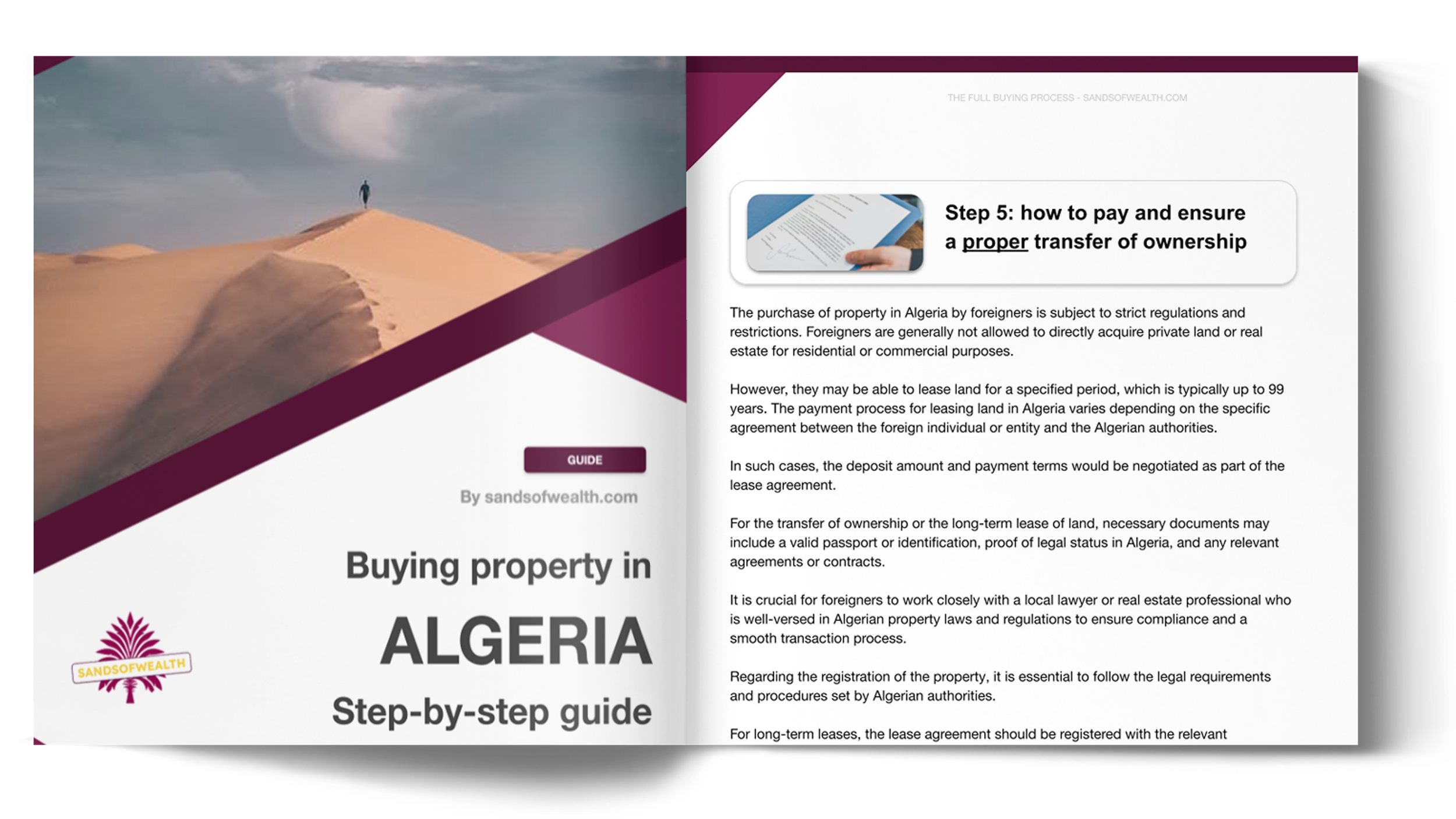
Everything you need to know before buying real estate is included in our Algeria Property Pack
Algeria's property market is showing mixed signals in 2025, with major cities like Algiers demonstrating resilience while secondary markets remain stagnant. Property prices in Algiers have stabilized after modest growth, while rental yields of 6-8% remain among the highest in North Africa, making it an attractive market for certain investor profiles.
If you want to go deeper, you can check our pack of documents related to the real estate market in Algeria, based on reliable facts and data, not opinions or rumors.
Algeria's property market offers decent opportunities in major cities, with Algiers leading at 60,000-120,000 DZD per sqm and rental yields reaching 8%.
The market faces a significant housing shortage with only 130,000 units supplied annually against 250,000-300,000 units of demand, supporting price stability in prime locations.
| City | Price Range (DZD/sqm) | Rental Yield | Investment Outlook |
|---|---|---|---|
| Algiers | 60,000-120,000 | 6-8% | Strong for premium areas |
| Oran | 40,000-80,000 | 5-7% | Moderate growth potential |
| Constantine | 30,000-60,000 | 4-6% | Stable, family-friendly |
| Annaba | 25,000-50,000 | 4-5% | Limited growth prospects |
| Tlemcen/Béjaïa | 20,000-40,000 | 3-5% | Entry-level opportunities |
| Sétif | 18,000-35,000 | 3-4% | Budget-friendly options |

What are property prices in Algeria right now, and how have they changed over the last year?
Property prices in Algeria are showing mixed trends as of September 2025, with Algiers leading the market at significantly higher prices than other major cities.
In Algiers, properties currently sell for 60,000–120,000 DZD per square meter, which translates to approximately $1,770 per square meter median price. Luxury neighborhoods in the capital can reach up to $2,500 per square meter, making them the most expensive in the country.
Other major cities show more affordable price ranges: Oran properties trade between 40,000–80,000 DZD per square meter, while Constantine ranges from 30,000–60,000 DZD, and Annaba from 25,000–50,000 DZD per square meter. Secondary cities like Tlemcen and Béjaïa offer entry-level opportunities at 20,000–40,000 DZD per square meter, with Sétif being the most affordable at 18,000–35,000 DZD per square meter.
Over the past year, the Algerian property market experienced a correction after earlier growth. Algiers saw property prices rise 7.2% in 2024, but this growth has now flattened significantly. Some neighborhoods in the capital even experienced price declines of up to 14.8% due to increased supply hitting the market.
Looking at five-year trends, Algiers has gained 10–20% overall, while Oran and Constantine showed more modest increases of 5–15%. Emerging areas like Tizi Ouzou performed best with gains of 15–25% over the same period.
How are prices expected to move in the short term, medium term, and long term?
Algeria's property price forecasts show cautious optimism with stronger growth potential in developing areas compared to established major cities.
In the short term for 2026, major cities like Algiers and Oran are expected to see modest price increases of 0–3%. This conservative forecast reflects market stabilization after recent supply increases and economic uncertainties. Developing areas may outperform with growth up to 7%, driven by infrastructure improvements and emerging demand.
The medium-term outlook for 2030 projects more substantial gains, with major cities potentially seeing 10–20% appreciation over the five-year period. Developing areas could experience higher growth rates in select locations, particularly those benefiting from government infrastructure investments and tourism development projects.
Long-term forecasts to 2035 suggest significant potential, with major cities projected to gain 15–40% over the decade. Developing hotspots could see appreciation of up to 40%, especially areas benefiting from economic diversification away from oil dependency and tourism infrastructure development.
These forecasts depend heavily on successful implementation of economic reforms, infrastructure investment, and political stability. The government's ability to execute large housing programs like AADL3 will also impact supply dynamics and price trajectories.
Which cities or regions in Algeria are seeing the fastest price growth, and which ones are stagnating?
The Algerian property market shows clear regional winners and losers, with coastal and capital areas significantly outperforming inland and rural markets.
The fastest-growing markets are concentrated in Algiers, particularly in premium neighborhoods like Hydra and El Madania, which continue to attract high-income buyers and investors. Tizi Ouzou has emerged as another growth leader, benefiting from its proximity to Algiers and ongoing infrastructure development. Coastal development projects are also showing strong momentum, driven by tourism potential and lifestyle demand.
Oran maintains steady growth, particularly in its coastal business districts, though at a more moderate pace than Algiers. Constantine shows stable but limited growth, serving primarily local demand rather than investment flows.
Stagnating markets include most outlying and rural areas, where demand remains weak and economic opportunities limited. Some secondary city neighborhoods are also experiencing flat or declining prices due to population outmigration to major urban centers.
Interestingly, even within Algiers, certain areas are stagnating due to oversupply issues. Some neighborhoods experienced the 14.8% price declines mentioned earlier when new developments flooded the market faster than demand could absorb them.
It's something we develop in our Algeria property pack.
What are the average prices by property type—apartments, houses, and land—in the main urban areas?
Property prices in Algeria vary significantly by type and location, with apartments in Algiers city center commanding premium prices while houses offer more space at varied price points depending on neighborhood quality.
| Property Type | Location | Price Range | Key Features |
|---|---|---|---|
| Apartments | Algiers Center | €169.55 ($180)/sqm | High demand, limited supply |
| Apartments | Algiers Outskirts | €99.98 ($106)/sqm | More affordable, growing areas |
| Houses (Luxury) | Top Neighborhoods | Up to $2,500/sqm | Premium locations, high-end finishes |
| Houses (Standard) | Affordable Areas | $1,200–1,400/sqm | Family-oriented, good value |
| Land (Premium) | Algiers Coastal | Upper price bracket | Development potential, sea access |
| Land (Remote) | Rural Areas | Significantly lower | Limited infrastructure, low demand |
Don't lose money on your property in Algeria
100% of people who have lost money there have spent less than 1 hour researching the market. We have reviewed everything there is to know. Grab our guide now.

What are the rental yields like across different cities and property types?
Algeria offers some of the highest rental yields in North Africa, with Algiers leading the market at 6-8% annual returns, making it particularly attractive for income-focused investors.
Central Algiers delivers the strongest rental yields at 6-8%, driven by high demand from business professionals, government workers, and expatriates. This yield range significantly outperforms many regional markets and reflects the capital's economic importance and housing shortage.
Oran follows with solid yields of 5-7%, particularly in coastal business districts where demand comes from both local professionals and seasonal tourism. The city's role as a major commercial hub supports consistent rental demand throughout the year.
Constantine and Annaba offer more modest yields of 4-6% and 4-5% respectively, appealing mainly to local renters rather than high-income tenants. These markets provide stable but lower returns compared to the major economic centers.
Secondary cities like Tlemcen, Béjaïa, and Sétif generate yields of 3-5%, suitable for investors seeking entry-level opportunities with limited competition but also limited upside potential.
The strongest rental locations include Algiers due to job migration and economic concentration, Oran for coastal business activities, and emerging tourism zones that are beginning to attract short-term rental demand.
How strong is the demand for rentals right now, and what are the trends for the next few years?
Rental demand in Algeria is currently robust in major economic centers, driven by urbanization trends and internal migration patterns, with strong growth expected to continue over the next several years.
Current demand is strongest in Algiers, where job migration from other regions creates consistent need for rental housing. The capital's role as the center of government, business, and education ensures steady tenant flow. Occupancy rates remain high in desirable neighborhoods, with quality properties often renting quickly.
Oran shows rising demand, particularly in coastal business areas where commercial activity and port operations attract workers. The city benefits from both permanent residents and seasonal demand from business travelers and tourists.
Industrial and coastal areas across the country are experiencing moderate but growing demand as economic diversification efforts create new employment centers outside traditional urban areas.
Future trends point to continued urbanization driving rental demand in major cities. Government efforts to develop new industrial zones and tourism infrastructure should create additional rental hotspots over the next few years. However, rural and less economically dynamic regions will likely see softer rental demand.
Rising rents in economic hubs reflect this strong demand, with property owners benefiting from both higher occupancy rates and increasing rental rates, particularly in well-located and quality properties.
What is the level of new construction and housing supply compared to demand?
Algeria faces a significant housing shortage with a substantial gap between supply and demand, creating underlying support for property prices and rental markets in major cities.
The country has an estimated annual housing demand of 250,000–300,000 units, driven by population growth, urbanization, and household formation. However, actual supply delivers only approximately 130,000 units annually, creating a massive shortfall that supports price stability and rental demand.
The government has ambitious housing programs in the pipeline, including AADL3 which aims to deliver 1.4 million homes. However, execution has been slow due to bureaucratic processes, funding challenges, and construction capacity constraints. This means the supply shortage is likely to persist for several years.
New construction is concentrated primarily in major cities and government-sponsored developments. Private sector construction faces various hurdles including land availability, permitting processes, and financing challenges, limiting its ability to address the supply gap effectively.
The supply-demand imbalance is most acute in prime locations within major cities, where land scarcity and regulatory constraints limit new development. This creates particular opportunities for investors in well-located existing properties.
It's something we develop in our Algeria property pack.
How easy is it to resell a property in Algeria today, and what's the average resale timeline?
Property resale liquidity in Algeria varies dramatically by location, with major cities offering good marketability while secondary and rural markets can be challenging for sellers.
Resale is easiest in major cities, particularly Algiers and Oran, where investor and end-user demand creates active secondary markets. Properties in desirable neighborhoods of these cities can sell within weeks to a few months, especially if priced competitively and in good condition.
Central Algiers properties, particularly in established neighborhoods like Hydra, El Madania, and downtown areas, typically enjoy the fastest resale times due to consistent buyer interest from both investors and affluent locals.
Oran properties also resell relatively quickly, especially those in coastal areas or business districts where demand from both local buyers and investors remains steady.
Secondary cities like Constantine and Annaba offer moderate liquidity, with resale timelines typically ranging from several months to over a year depending on property type, condition, and pricing.
Rural and remote areas present significant challenges for resale, with limited buyer pools and extended marketing periods that can stretch beyond a year. These markets require substantial patience and often significant price concessions to achieve sales.
The overall resale market benefits from the housing shortage, which ensures some level of demand even in slower markets, though timing and pricing remain critical factors for successful transactions.

We did some research and made this infographic to help you quickly compare rental yields of the major cities in Algeria versus those in neighboring countries. It provides a clear view of how this country positions itself as a real estate investment destination, which might interest you if you're planning to invest there.
What are the main risks—economic, political, or currency-related—that could affect property values?
Algeria's property market faces several significant risks that potential buyers should carefully consider, ranging from economic instability to political uncertainties and currency volatility.
Economic risks include high inflation at 9.4% in 2025, sluggish economic growth, and unemployment rates that remain elevated. The economy's heavy dependence on oil and gas exports creates vulnerability to commodity price swings, which can impact government spending, employment, and overall economic confidence.
Political risks center around potential instability and the highly state-dominated economic system. Bureaucratic hurdles can complicate property transactions, while policy changes could affect foreign ownership rules or taxation. The government's ability to implement promised economic reforms remains uncertain, with delays potentially impacting infrastructure development and economic diversification efforts.
Currency-related risks involve ongoing Dinar devaluation, which creates both opportunities and challenges. While devaluation can make properties more attractive to foreign buyers with hard currencies, it also creates volatility and uncertainty for local buyers and can impact construction costs for materials that must be imported.
Additional risks include construction cost volatility due to material price fluctuations and supply chain issues. The country's continued reliance on the oil and gas sector makes the broader economy vulnerable to global energy market cycles, which can indirectly affect property demand and values.
Regulatory risks include potential changes to property laws, foreign ownership restrictions, or taxation policies that could impact investment returns or resale liquidity.
What budget ranges are the most attractive today if you want to invest?
Algeria offers distinct investment opportunities across different budget ranges, with each segment providing unique advantages depending on investor goals and risk tolerance.
The entry-level investor segment focuses on properties priced at 20,000–40,000 DZD per square meter in cities like Sétif, Béjaïa, and Tlemcen. These markets offer affordable entry points with potential for modest appreciation as infrastructure develops, though liquidity and rental demand remain limited.
The mid-market range of 40,000–80,000 DZD per square meter in Oran, Constantine, and Annaba provides a balance between affordability and market stability. These cities offer better liquidity than entry-level markets while still providing reasonable acquisition costs and decent rental potential.
The prime investment category targets properties over 60,000 DZD per square meter in top Algiers zones like Hydra and El Madania. This segment offers the strongest rental yields at 6-8%, best resale liquidity, and highest appreciation potential, though requiring larger capital commitments.
For international investors with USD access, the $1,200–1,800 per square meter range in rising districts offers attractive opportunities, while $2,000+ per square meter provides access to luxury properties with speculative growth potential.
Budget-conscious investors should consider that the mid-market range often provides the best risk-adjusted returns, combining reasonable acquisition costs with acceptable liquidity and rental demand.
If you're buying to live in Algeria, which areas offer the best balance between price, safety, and amenities?
For residents seeking the optimal combination of livability factors, several Algiers neighborhoods and secondary cities provide excellent value propositions for different lifestyle preferences and budgets.
Balanced areas in Algiers include Kouba, El Achour, and El Harrach, which offer reasonable property prices while maintaining good safety records and solid amenities. These neighborhoods provide access to schools, healthcare, shopping, and transportation while avoiding the premium prices of the most prestigious districts.
Premium liveability areas include Hydra, El Biar, and Bir Mourad Raïs, which command higher property prices but deliver excellent amenities, top safety ratings, and proximity to diplomatic areas and international schools. These neighborhoods are ideal for expatriates and affluent professionals willing to pay for quality of life.
Family-friendly options outside Algiers include Constantine and Annaba, which offer moderate property costs, solid amenities, and less congestion than the capital. These cities provide good schools, healthcare facilities, and cultural amenities while maintaining more relaxed lifestyles than major metropolitan areas.
Constantine particularly appeals to families seeking academic environments, given its university presence and cultural significance. Annaba offers coastal lifestyle benefits with Mediterranean access while maintaining reasonable property costs.
Safety considerations generally favor established neighborhoods in major cities over newer developments or peripheral areas, though crime rates remain relatively manageable compared to many regional peers.
If you're buying for investment, which cities, property types, and price ranges give the best short-term rental income and long-term capital gains?
Investment success in Algeria requires targeting specific combinations of location, property type, and price range that optimize both rental income and appreciation potential.
For short-term rental income, central Algiers properties deliver the strongest returns at 6-8% yields. Focus on apartments in Hydra, El Madania, and downtown areas where business travelers, government contractors, and expatriates create consistent demand. Well-located apartments in the $1,500–2,000 per square meter range typically provide optimal rental returns.
Oran coastal properties also generate solid rental income, particularly in business districts where commercial activity supports both permanent and temporary housing demand. Properties near the port and business centers perform well for rental investment strategies.
For capital gains potential, Algiers remains the primary target, particularly in neighborhoods benefiting from infrastructure development and urban renewal projects. Tizi Ouzou offers emerging opportunities driven by infrastructure improvements and tourism development potential.
Select coastal development projects provide speculative opportunities for long-term appreciation, especially those aligned with government tourism development plans. However, these require careful due diligence and higher risk tolerance.
The optimal investment sweet spot appears to be $1,200–1,800 per square meter in rising districts of Algiers, providing balance between acquisition cost, rental potential, and appreciation prospects. Properties over $2,000 per square meter should be reserved for luxury markets with proven demand and superior locations.
It's something we develop in our Algeria property pack.
Conclusion
This article is for informational purposes only and should not be considered financial advice. Readers are advised to consult with a qualified professional before making any investment decisions. We do not assume any liability for actions taken based on the information provided.
Algeria's property market presents a mixed opportunity landscape in 2025, with major cities like Algiers offering solid rental yields and appreciation potential while secondary markets remain challenging.
The significant housing shortage of 120,000-170,000 units annually supports price stability and rental demand, particularly in prime locations where infrastructure development and economic activity concentrate.