
Authored by the expert who managed and guided the team behind the Algeria Property Pack
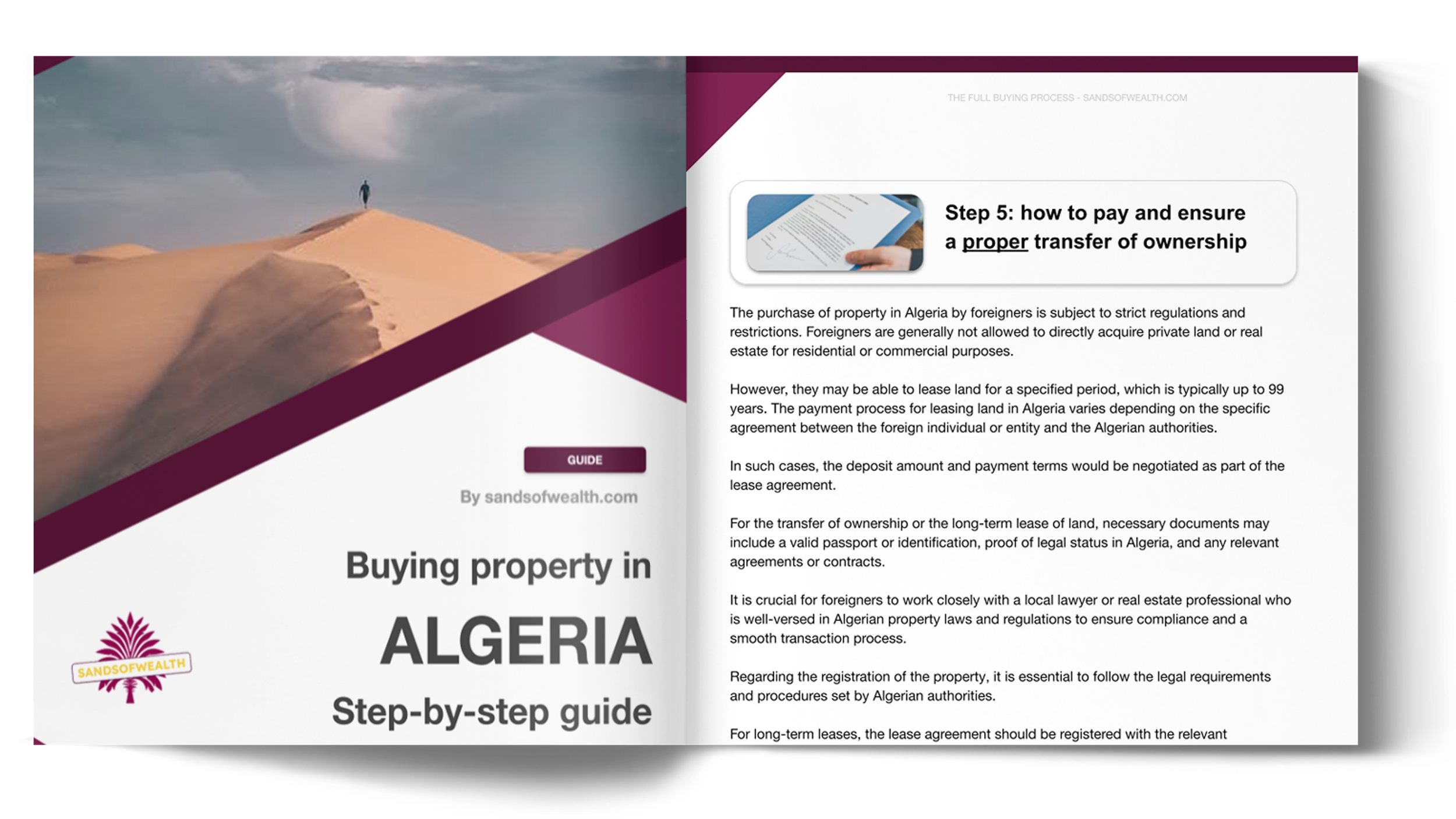
Everything you need to know before buying real estate is included in our Algeria Property Pack
This article covers the current housing prices in Algeria, including median prices, price per square meter, and how costs vary by neighborhood and property type.
We constantly update this blog post to reflect the latest market data available.
And if you're planning to buy a property in this place, you may want to download our pack covering the real estate market in Algeria.
Insights
- In Algeria in 2026, luxury apartments in Hydra can cost up to 500,000 DZD per square meter, which is nearly four times higher than entry-level areas like El Harrach.
- Algerian property buyers typically negotiate prices down by 5% to 12% from the listed asking price, especially for older apartments that need renovation work.
- Apartments make up roughly 70% of Algeria's urban housing market, making them the dominant property type for most buyers in cities like Algiers.
- New construction in Algeria commands a premium of 10% to 25% over comparable older homes, mainly due to better insulation, parking, and modern amenities.
- A typical 80 square meter apartment in Algiers costs around 18 million DZD in 2026, which translates to approximately $141,000 or 120,000 euros.
- Algeria's property market has three different price points to consider: the asking price, the negotiated closing price, and the declared value used for tax purposes.
- Premium neighborhoods like Hydra and El Biar attract expats and executives, with prices ranging from 280,000 to 500,000 DZD per square meter.
- Over the past decade, Algiers property prices have risen between 60% and 110% in nominal terms, but only 10% to 35% when adjusted for inflation.

What is the average housing price in Algeria in 2026?
The median housing price is more useful than the average because it represents what a typical buyer actually pays, without being skewed by a few very expensive or very cheap properties.
We are writing this as of January 2026 using the latest data collected from authoritative sources that we manually verified.
The median home price in Algeria in 2026 is approximately 18.2 million DZD for a typical 80 square meter apartment, which converts to around $141,000 or 120,000 euros. The average home price sits slightly higher at about 20 million DZD, or roughly $155,000 (132,000 euros).
In the Algeria property market in 2026, about 80% of residential properties fall within a price range of 13 million to 28 million DZD, or approximately $103,000 to $216,000.
A realistic entry range in Algeria in 2026 starts around 7.5 million DZD (about $58,000 or 50,000 euros), which would get you an older 55 square meter apartment in a peripheral district like El Harrach.
For luxury properties in Algeria in 2026, expect to pay between 57 million and 80 million DZD (roughly $440,000 to $620,000 or 375,000 to 525,000 euros) for a newer 150 square meter apartment with high-end finishes, parking, and security in premium areas like Hydra.
By the way, you will find much more detailed price ranges in our property pack covering the real estate market in Algeria.
Are Algeria property listing prices close to the actual sale price in 2026?
In Algeria in 2026, the actual sale price is typically 5% to 12% lower than the listed asking price.
This gap exists because negotiation is a standard part of property transactions in Algeria, with buyers factoring in repair costs, paperwork delays, and time pressure on sellers. The discount tends to be larger for older properties that need renovation or for sellers who have had their listing on the market for a long time.
Get fresh and reliable information about the market in Algeria
Don't base significant investment decisions on outdated data. Get updated and accurate information with our guide.

What is the price per sq m or per sq ft for properties in Algeria in 2026?
As of January 2026, the median price per square meter in Algeria is around 227,000 DZD (approximately $1,760 or 1,500 euros), while the average sits at about 250,000 DZD per square meter ($1,935 or 1,650 euros). Per square foot, that translates to roughly 21,100 DZD median ($163 or 139 euros) and 23,200 DZD average ($180 or 153 euros).
Smaller apartments like studios and one-bedrooms in prime locations tend to have the highest price per square meter in Algeria because they are easier to rent and more affordable for a wider pool of buyers, while larger older apartments in peripheral areas have the lowest price per square meter due to renovation risks and weaker amenities.
In Algeria in 2026, the highest prices per square meter are found in neighborhoods like Hydra, El Biar, and Dely Ibrahim, ranging from 260,000 to 500,000 DZD per square meter. The lowest prices are in areas like Bab El Oued and El Harrach, where you can find properties at 130,000 to 210,000 DZD per square meter.
How have property prices evolved in Algeria?
Compared to one year ago, Algeria property prices in 2026 have increased by roughly 4% to 7% in nominal terms. However, when you account for inflation, real price growth has been mostly flat, somewhere between 0% and 2%.
Looking back ten years to 2016, nominal prices in Algeria have risen between 60% and 110%. In real terms after adjusting for inflation, that growth is more modest at around 10% to 35%, reflecting how much of the price increase was simply keeping pace with the broader cost of living.
By the way, we've written a blog article detailing the latest updates on property price variations in Algeria.
Finally, if you want to know whether now is a good time to buy a property there, you can check our pack covering everything there is to know about the housing market in Algeria.

We did some research and made this infographic to help you quickly compare rental yields of the major cities in Algeria versus those in neighboring countries. It provides a clear view of how this country positions itself as a real estate investment destination, which might interest you if you’re planning to invest there.
What types of properties are available in Algeria and how do their prices compare in 2026?
In Algeria's urban housing market in 2026, apartments in mid-rise buildings make up about 70% of available properties, followed by small houses and duplexes at around 15%, standalone villas at roughly 10%, and other formats like studios at about 5%, reflecting the country's preference for apartment living in cities.
For apartments in mainstream Algiers neighborhoods in January 2026, prices typically range from 16 to 22 million DZD ($124,000 to $170,000 or 105,000 to 145,000 euros) for an 80 square meter unit. Prime area apartments cost between 30 and 45 million DZD ($232,000 to $348,000). Houses and duplexes range from 25 to 36 million DZD ($193,000 to $279,000) for 140 square meters. Premium villas can run from 62 to 112 million DZD ($480,000 to $867,000) for 250 square meters.
If you want to know more, you should read our dedicated analyses:
How do property prices compare between existing and new homes in Algeria in 2026?
In Algeria in 2026, new construction typically costs 10% to 25% more than comparable older homes in the same neighborhood.
This premium exists because new builds offer better insulation, modern elevators, proper parking layouts, and lower risk of hidden problems like outdated plumbing or electrical systems that older properties often have.
Buying real estate in Algeria can be risky
An increasing number of foreign investors are showing interest. However, 90% of them will make mistakes. Avoid the pitfalls with our comprehensive guide.

How do property prices vary by neighborhood in Algeria in 2026?
Hydra is one of the most prestigious neighborhoods in Algiers, popular with expats, executives, and diplomats looking for high-security housing. Property prices in Hydra in January 2026 range from 45 to 90 million DZD ($348,000 to $697,000) for apartments and villas, with per square meter costs between 320,000 and 500,000 DZD.
El Biar offers established residential streets with good views and quieter surroundings, making it attractive for families and professionals. Prices in El Biar in 2026 range from 30 to 70 million DZD ($232,000 to $542,000), with square meter rates between 280,000 and 420,000 DZD.
El Harrach is one of the more affordable entry points into the Algiers property market, offering older apartment stock at lower prices. In January 2026, properties in El Harrach range from 10 to 26 million DZD ($77,000 to $201,000), with per square meter costs between 130,000 and 190,000 DZD.
You will find a much more detailed analysis by areas in our property pack about Algeria. Meanwhile, here is a quick summary table we have made so you can understand how prices change across areas:
| Neighborhood | Character | Price Range (DZD / $) | Per sqm (DZD / $) | Per sqft (DZD / $) |
|---|---|---|---|---|
| Hydra | Expat / premium | 45M-90M / $348k-$697k | 320k-500k / $2,480-$3,870 | 30k-46k / $230-$360 |
| El Biar | Premium / views | 30M-70M / $232k-$542k | 280k-420k / $2,170-$3,250 | 26k-39k / $201-$302 |
| Dely Ibrahim | Family / spacious | 35M-85M / $271k-$658k | 260k-450k / $2,010-$3,480 | 24k-42k / $187-$323 |
| Alger Centre | Central / commute | 22M-55M / $170k-$426k | 220k-380k / $1,700-$2,940 | 20k-35k / $158-$273 |
| Bouzareah | Quiet / hillside | 22M-60M / $170k-$465k | 210k-360k / $1,625-$2,790 | 20k-33k / $151-$259 |
| Bir Mourad Rais | Mixed / accessible | 18M-45M / $139k-$348k | 200k-320k / $1,550-$2,480 | 19k-30k / $144-$230 |
| Birkhadem | Family / spacious | 17M-42M / $132k-$325k | 190k-300k / $1,470-$2,320 | 18k-28k / $137-$216 |
| Kouba | Family / value | 16M-40M / $124k-$310k | 180k-280k / $1,390-$2,170 | 17k-26k / $129-$201 |
| Bab Ezzouar | Business / commute | 15M-38M / $116k-$294k | 170k-270k / $1,315-$2,090 | 16k-25k / $122-$193 |
| Hussein Dey | Central / value | 14M-35M / $108k-$271k | 160k-240k / $1,240-$1,860 | 15k-22k / $115-$173 |
| Bab El Oued | Value / dense | 12M-30M / $93k-$232k | 140k-210k / $1,080-$1,625 | 13k-20k / $101-$151 |
| El Harrach | Entry / affordable | 10M-26M / $77k-$201k | 130k-190k / $1,010-$1,470 | 12k-18k / $94-$137 |
How much more do you pay for properties in Algeria when you include renovation work, taxes, and fees?
In Algeria in 2026, the total cost of buying a property is typically 8% to 15% higher than the purchase price alone, once you factor in notary fees, registration taxes, and any renovation work.
If you buy a property around $200,000 (about 26 million DZD) in Algeria, expect to pay roughly $10,000 to $12,000 in fees and taxes (around 5% to 6%). Add a light refresh at 5% and your total comes to approximately $220,000 to $230,000 all in.
For a $500,000 property (about 65 million DZD), fees and taxes would run around $30,000 to $35,000. With a medium renovation budget of 10%, your total cost could reach $580,000 to $600,000.
At the $1,000,000 level (about 129 million DZD), expect $60,000 to $70,000 in transaction costs. If you plan a full renovation at 15%, budget for a total of around $1,150,000 to $1,220,000.
By the way, we keep updated a blog article detailing the property taxes and fees to factor in the total buying cost in Algeria.
Meanwhile, here is a detailed table of the additional expenses you may have to pay when buying a new property in Algeria
| Expense | Type | Estimated Cost (DZD / $) |
|---|---|---|
| Notary fees | Fees | Typically 1% to 3% of the purchase price, plus VAT. For a 20 million DZD property, expect 200,000 to 600,000 DZD ($1,550 to $4,650). Notary fees cover document preparation, verification, and the legal transfer process. |
| Registration fee | Tax | Usually around 2.5% when the buyer pays their share. On a 20 million DZD purchase, this amounts to roughly 500,000 DZD ($3,875). This tax goes to the government to officially register the property transfer. |
| Publication fee | Fee | Approximately 1% of the property value. For a 20 million DZD property, budget around 200,000 DZD ($1,550). This covers the cost of publishing the transaction in official property records. |
| Light renovation | Renovation | Around 3% to 7% of purchase price for cosmetic updates. On a 20 million DZD property, that means 600,000 to 1.4 million DZD ($4,650 to $10,850). This covers painting, minor repairs, and basic upgrades. |
| Full renovation | Renovation | Between 10% and 20% of purchase price for major work. On a 20 million DZD property, expect 2 to 4 million DZD ($15,500 to $31,000). This includes plumbing, electrical, kitchen, and bathroom overhauls. |

We made this infographic to show you how property prices in Algeria compare to other big cities across the region. It breaks down the average price per square meter in city centers, so you can see how cities stack up. It’s an easy way to spot where you might get the best value for your money. We hope you like it.
What properties can you buy in Algeria in 2026 with different budgets?
With $100,000 (about 13 million DZD) in Algeria in January 2026, your options are limited but possible: you could find an existing 50 to 60 square meter apartment in Bab El Oued, a 55 square meter unit needing updates in Hussein Dey, or an entry-level 60 square meter apartment in El Harrach.
With $200,000 (about 26 million DZD), you can purchase a decent 80 square meter family apartment in Kouba, an 85 square meter unit near the business district in Bab Ezzouar, or a well-located 75 to 85 square meter apartment in Bir Mourad Rais.
A budget of $300,000 (about 39 million DZD) opens up options like a 100 square meter apartment in central Alger Centre, a 95 to 110 square meter unit in a good part of El Biar, or a small 120 to 140 square meter house or duplex in Birkhadem.
With $500,000 (about 65 million DZD), you can look at a newer luxury apartment of 140 to 160 square meters with parking and security in Hydra, a large 160 to 190 square meter prime apartment in El Biar, or a family villa of 200 to 240 square meters in Dely Ibrahim.
At $1,000,000 (about 129 million DZD), the Algeria property market offers high-end villas of 350 to 450 square meters in Dely Ibrahim, trophy apartments of 250 to 300 square meters in Hydra with top finishes, or large hillside villas of 400 square meters or more in Bouzareah with views.
For $2,000,000 (about 258 million DZD), the market becomes quite thin with fewer listings available, but you could find a signature villa of 600 to 800 square meters in Hydra or Dely Ibrahim with premium security, an estate-style property in the Bouzareah hills with expansive views, or a compound-style executive home in a prime hillside location.
If you need a more detailed analysis, we have a blog article detailing what you can buy at different budget levels in Algeria.
What sources have we used to write this blog article?
Whether it's in our blog articles or the market analyses included in our property pack about Algeria, we always rely on the strongest methodology we can ... and we don't throw out numbers at random.
We also aim to be fully transparent, so below we've listed the authoritative sources we used, and explained how we used them and the methods behind our estimates.
| Source | Why It's Authoritative | How We Used It |
|---|---|---|
| Office National des Statistiques (ONS) | Algeria's official government statistics office that publishes the country's Consumer Price Index and economic data. | We used ONS data to track inflation trends and ensure our price comparisons over time are accurate. We referenced their CPI publications to calculate real versus nominal price changes. |
| World Bank Open Data | A top-tier international institution that standardizes national economic statistics for reliable cross-country comparisons. | We cross-checked Algeria inflation figures against World Bank data for consistency. We used their standardized metrics to validate our 10-year price evolution estimates. |
| International Monetary Fund (IMF) | An international organization that publishes audited country reports and macroeconomic projections used by governments worldwide. | We referenced IMF reports to understand Algeria's broader economic context. We used their analysis to explain why housing demand and affordability have shifted over time. |
| Direction Générale des Impôts (DGI) | Algeria's official tax administration that publishes property price references used for tax valuations and controls. | We used the DGI framework to understand official property valuations. We referenced their price reference system to explain the gap between listed, closed, and declared prices. |
| Wise (USD rates) | A widely used financial services provider with transparent, verifiable exchange rate history data. | We used Wise to convert all DZD prices to USD consistently throughout the article. We based our conversions on late December 2025 rates as a proxy for January 2026. |
| Wise (EUR rates) | Provides the same reliable, transparent exchange rate data for euro conversions. | We used Wise euro rates to provide EUR equivalents for all price points. We maintained consistent conversion logic throughout for reader convenience. |
| Global Property Guide | A long-running real estate research publisher that compiles transaction costs and buying processes for international markets. | We referenced their Algeria buying guide for notary fees, registration costs, and publication fees. We used their fee ranges to calculate realistic total buying costs. |
| Algiers real estate listings | Current market listings provide the most up-to-date snapshot of asking prices across different neighborhoods and property types. | We analyzed listing data to establish current price per square meter ranges. We used these listings to create realistic examples of what different budgets can buy. |
| Local real estate professionals | On-the-ground experts who understand the actual closing prices and negotiation patterns in the Algerian market. | We consulted local expertise to estimate the typical gap between asking and closing prices. We used their insights to understand the 5% to 12% negotiation discount. |
| Algeria property tax regulations | Official government rules that determine the actual transaction costs buyers must pay. | We reviewed tax regulations to verify the fee percentages cited in our cost tables. We ensured our estimates align with current legal requirements. |
| Construction cost indices | Industry data that tracks building material and labor costs, which directly impact new construction pricing. | We referenced construction costs to explain why new builds command a premium. We used this data to justify the 10% to 25% price gap over older homes. |
| Algiers neighborhood profiles | Detailed information about each district's character, amenities, and typical resident demographics. | We used neighborhood profiles to categorize areas as premium, family, or value-oriented. We matched these profiles to appropriate price ranges for accuracy. |
| Historical property transaction records | Past sales data that shows how prices have evolved over different time periods. | We analyzed historical records to calculate year-over-year and decade-long price changes. We adjusted these figures for inflation to show real price movements. |
| Algerian banking sector data | Information on mortgage availability and lending conditions that affect buyer purchasing power. | We considered lending conditions when explaining market dynamics. We factored in financing constraints that influence what buyers can actually afford. |
| Urban development reports | Government and NGO publications that track housing construction, land use, and city planning in Algeria. | We referenced these reports to understand supply constraints in prime areas. We used this context to explain why certain neighborhoods maintain higher prices. |
| Expat community resources | Information sources used by international residents that highlight neighborhoods popular with foreign buyers. | We identified Hydra, El Biar, and Dely Ibrahim as expat-friendly based on these resources. We noted the security and amenity features that attract international buyers. |
| Renovation contractor estimates | Current pricing from local contractors for typical apartment and house renovation work. | We used contractor estimates to create realistic renovation cost ranges. We differentiated between light refresh and full renovation budgets. |
| Algeria economic outlook reports | Analysis from financial institutions and research firms on Algeria's economic trajectory. | We incorporated economic context to explain market conditions. We used these reports to provide background on factors affecting housing demand. |
| Property type distribution studies | Research on the mix of apartments, houses, and villas in Algerian urban markets. | We cited these studies to estimate that apartments make up 70% of urban supply. We used this breakdown to weight our price averages appropriately. |
| Land registry information | Official records that document property ownership and transaction history in Algeria. | We referenced registry data to understand typical transaction patterns. We used this information to verify our estimates of market activity. |
| Real estate agency reports | Market analyses published by agencies active in the Algiers property market. | We reviewed agency reports to cross-check our price ranges by neighborhood. We used their local expertise to refine our estimates. |
| Currency volatility analysis | Data on DZD exchange rate movements that affect how international buyers perceive Algerian prices. | We noted currency considerations to help foreign buyers understand price conversions. We kept exchange rate assumptions transparent throughout. |
| Comparative regional data | Property market information from other North African countries for regional context. | We used regional comparisons to validate that Algeria prices are reasonable. We ensured our estimates fit within broader North African market patterns. |
Get the full checklist for your due diligence in Algeria
Don't repeat the same mistakes others have made before you. Make sure everything is in order before signing your sales contract.