
Authored by the expert who managed and guided the team behind the Algeria Property Pack
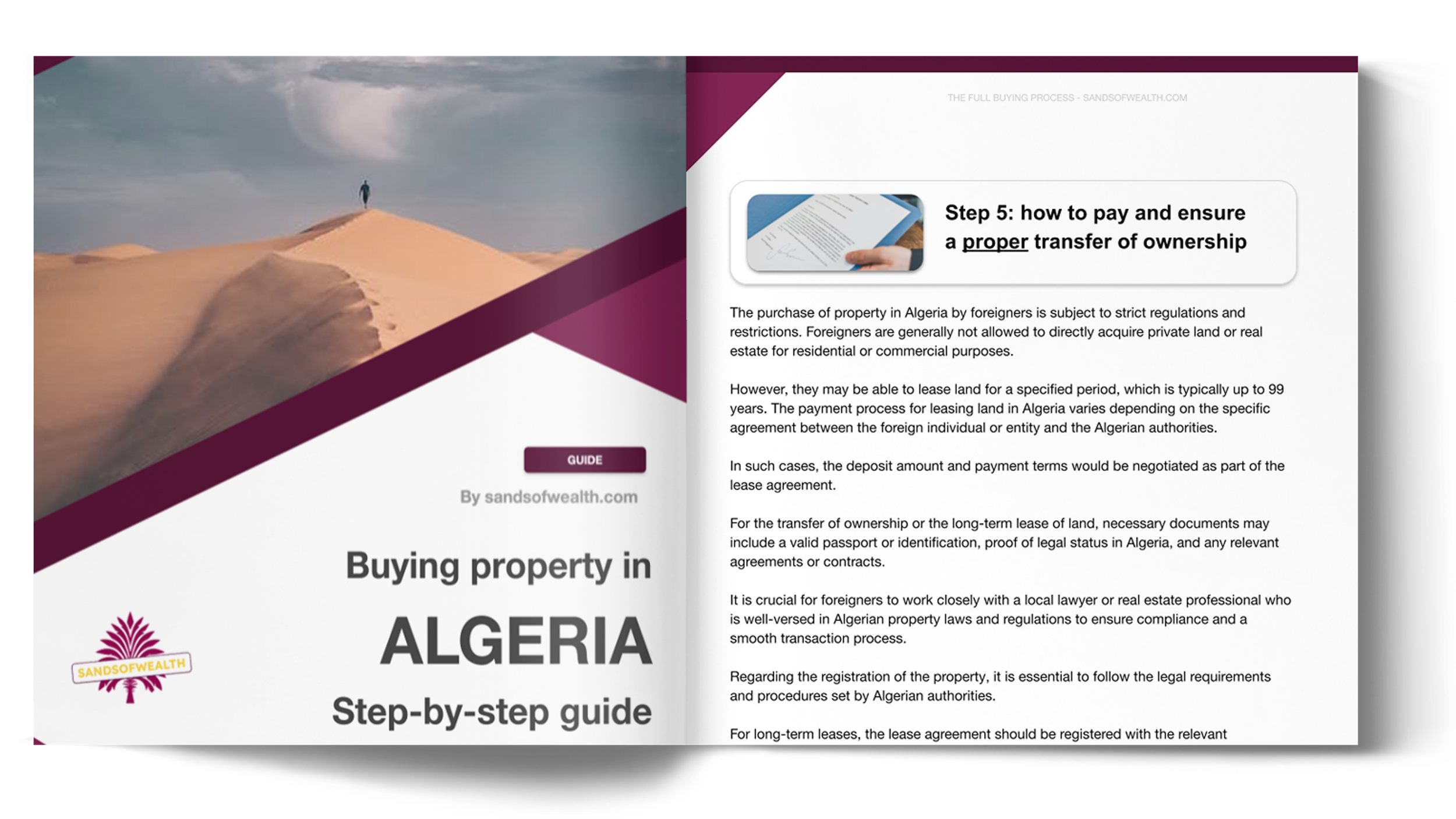
Get all the data you need about the real estate market in Algeria
This article is constantly updated, and this Algeria foreign property ownership guide reflects the rules and market practice we could verify in June 2026.
Buying residential property in Algeria as a foreigner is possible in many normal cases, but the safest deals are clean, registered, urban homes with a notary-led file.
The main point is simple: do not treat an agent promise, family paper, or informal agreement as proof that you can safely own the property in Algeria.
And if you’re planning to buy a property in this place, you may want to download our pack covering the real estate market in Algeria.

What can I legally buy and truly own as a foreigner in Algeria?
What property types can foreigners legally buy in Algeria right now?
A foreign individual can usually look at private residential property in Algeria, including apartments, villas, individual houses, duplexes, small residential buildings, and urban residential plots meant for housing.
The most important condition is that the Algeria property must be private, registered, legally transferable, and transferred through a notary with proper land registry publication.
In practice, the easiest Algeria residential purchase for a foreigner is a registered apartment or house in an established area such as Hydra, El Biar, Kouba, Dely Ibrahim, Chéraga, Bab Ezzouar, Akid Lotfi, Bir El Djir, Canastel, Sidi Mabrouk, or Zouaghi.
The riskier Algeria property types are agricultural land, state-domain land, informal subdivisions, inherited homes with missing heir consent, and houses with unapproved extensions or unclear boundaries.
Finally, please note that our pack about the property market in Algeria is specifically tailored to foreigners.
Can I own land in my own name in Algeria right now?
Yes, a foreigner can in principle own private urban residential land in Algeria in their own name when the land is registered, transferable, and accepted through the notarial and land registry process.
However, this does not mean that every land parcel in Algeria is safe for foreign ownership, because agricultural land, state land, informal plots, and family-held land can be blocked or highly risky.
For apartments in Algeria, the buyer usually owns a private unit plus shared co-ownership rights, while for villas, houses, duplexes, and plots the land status must be checked much more carefully.
As of 2026, what other key foreign-ownership rules or limits should I know in Algeria?
As of 2026, the main extra rule in Algeria is not a simple foreign-buyer ban, but a heavier need to prove identity, source of funds, seller authority, tax compliance, and clean land registry status.
Algeria does not publish a clear apartment foreign-ownership quota rule like a fixed maximum percentage of foreign owners in one building.
The key registration requirement is that the real estate deed must go through the notary and then be published through the land registry system before the buyer can rely on final ownership proof.
No major official 2026 Algeria rule created a golden visa or a broad new foreigner quota for residential property, but tax and banking checks have become more important in practice.
If you're interested, we go much more into details about the foreign ownership rights in Algeria here.
What’s the biggest ownership mistake foreigners make in Algeria right now?
The biggest mistake foreigners make in Algeria is paying a deposit or serious money before the notary verifies the title, seller authority, inheritance status, taxes, land registry file, and planning status.
If a foreign buyer makes that mistake in Algeria, the buyer can end up with a delayed transfer, a blocked deed, a dispute with heirs, or money stuck in a deal that cannot close cleanly.
Other classic Algeria pitfalls include trusting old family papers, ignoring the livret foncier, accepting under-declared prices, missing illegal extensions, and buying in subdivisions that were never properly regularized.
Get fresh and reliable information about the market in Algeria
Don't base significant investment decisions on outdated data. Get updated and accurate information.

Which visa or residency status changes what I can do in Algeria?
Do I need a specific visa to buy property in Algeria right now?
In June 2026, Algeria does not publish a special property-buyer visa, so a visitor can inspect homes and start a file, but a visa does not replace title, tax, and notary requirements.
The most common non-property issue that can block a foreign buyer in Algeria is proving legal identity, address, banking route, source of funds, and valid signing authority if the buyer is abroad.
A local tax ID, known as a NIF in Algeria, is usually needed by the time taxes, registration, and later rental income are handled, even if the notary helps arrange the practical route.
A typical Algeria foreign-buyer file includes passport, visa or residence documents, marital status documents, proof of address, source-of-funds evidence, tax details, and a legalized power of attorney if someone signs for the buyer.
Does buying property help me get residency and citizenship in Algeria in 2026?
As of 2026, buying property in Algeria does not by itself give a foreigner residency, permanent residence, or Algerian citizenship.
Other routes to longer legal stay in Algeria usually depend on work, family, residence authorization, or naturalization conditions, not simply on buying an apartment, villa, house, or plot.
Can I legally rent out property on my visa in Algeria right now?
Your visa status does not usually stop you from passively owning and renting a residential property in Algeria, but it can stop you from personally working as a local property manager.
You do not need to live in Algeria to rent out a property, because a local representative, property manager, accountant, or notary can help handle leases, tax, repairs, and tenant issues.
The most important details are that long-term residential rent should be declared for tax, while furnished short-term letting or repeated commercial-style rentals may need more tax and business checks.
We cover everything there is to know about buying and renting out in Algeria here.
Get to know the market before buying a property in Algeria
Better information leads to better decisions. Get all the data you need before investing a large amount of money.
How does the buying process actually work step-by-step in Algeria?
What are the exact steps to buy property in Algeria right now?
The usual Algeria buying sequence is to choose the property, request title documents, verify seller authority, check registry and tax issues, check zoning if needed, sign through the notary, pay official costs, publish the deed, and collect final ownership proof.
You do not always need to be physically present in Algeria if a properly legalized power of attorney is accepted, but being present is safer for a first purchase.
The step that usually makes the Algeria deal legally binding is the signing of the authentic deed before the notary, followed by official registration and land-publicity steps.
A realistic Algeria timeline from accepted offer to final registration is often about one to three months for a clean apartment, and longer for villas, inherited property, land, or files involving foreign documents.
We have a document entirely dedicated to the whole buying process our pack about properties in Algeria.
Is it mandatory to get a lawyer or a notary to buy a property in Algeria right now?
A notary is effectively required for a real estate purchase in Algeria, while a lawyer is not always mandatory but is strongly recommended for foreign buyers and any non-standard property.
The notary prepares and authenticates the deed for the official transfer, while the lawyer protects the buyer’s interests and can challenge unclear title, inheritance, boundary, permit, or contract risks.
For an Algeria foreign-buyer engagement, the scope should clearly include title verification, seller authority, lien checks, tax exposure, planning status, and review of any power of attorney.
Make a profitable investment in Algeria
Better information leads to better decisions. Save time and money. Download our data.
What checks should I run so I don’t buy a problem property in Algeria?
How do I verify title and ownership history in Algeria right now?
To verify title and ownership history in Algeria, the notary should check the conservation foncière file and confirm that the seller’s ownership is properly registered.
The key document to request is the livret foncier, because it is the practical proof that the property is recorded through the land registry system.
A realistic look-back check in Algeria should cover the current registered owner, the previous transfer, and any inheritance or co-ownership chain that explains how the seller received the property.
A major red flag is any Algeria property where the seller has possession, old papers, or family agreement, but no clean registered title that the notary can verify.
You will find here the list of classic mistakes people make when buying a property in Algeria.
How do I confirm there are no liens in Algeria right now?
The standard way to confirm there are no liens in Algeria is to have the notary request land-registry information showing mortgages, seizures, restrictions, registered rights, and other encumbrances.
One common encumbrance to ask about in Algeria is a registered mortgage, especially if the seller used the property as collateral for a bank loan.
The best written proof is the land-registry extract or certificate obtained through the notary, ideally combined with tax and utility clearance checks before signing.
How do I check zoning and permitted use in Algeria right now?
To check zoning and permitted use in Algeria, use the local urban-planning authority and the Housing Ministry framework for the certificat d’urbanisme, POS, building permits, and conformity documents.
The key zoning reference is usually the POS, the Plan d’Occupation des Sols, supported by the certificat d’urbanisme for the specific property.
A common Algeria pitfall is buying a villa or house with an extra floor, garage conversion, boundary change, or extension that looks normal but was never properly permitted.
Don't buy the wrong property, in the wrong area of Algeria
Buying real estate is a significant investment. Don't rely solely on your intuition. Gather the right information to make the best decision.
Can I get a mortgage as a foreigner in Algeria, and on what terms?
Do banks lend to foreigners for homes in Algeria in 2026?
As of 2026, Algeria has residential mortgages, but ordinary non-Algerian foreign buyers should not assume local banks will lend to them.
For a non-Algerian buyer in Algeria, a realistic planning range is often 0% to 60% loan-to-value, with 0% meaning no local mortgage is approved.
The main eligibility factor is usually a strong local file, such as residence, documented income, a compliant bank account, clear source of funds, and sometimes family or employer links in Algeria.
Which banks are most foreigner-friendly in Algeria in 2026?
As of 2026, the most relevant banks to approach for an Algeria home loan are CNEP Banque, BNH, and BNA, but this means housing-finance relevance, not guaranteed foreigner approval.
The feature that makes these banks more useful is that they publish housing-credit products and work in the residential finance market, which gives buyers a starting point for a case review.
For non-residents without Algeria income or residence, these banks should be treated as unlikely lenders, so foreign buyers should also plan cash or financing from abroad.
We actually have a specific document about how to get a mortgage as a foreigner in our pack covering real estate in Algeria.
What mortgage rates are foreigners offered in Algeria in 2026?
As of 2026, a foreigner who actually qualifies for Algeria housing finance should roughly expect 6.5% to 8% nominal annual interest, with refusal still possible.
Fixed and variable pricing is not always marketed to foreigners in a transparent way, so the bigger difference in Algeria is usually eligibility and documentation, not a clean fixed-versus-variable spread.
Get fresh and reliable information about the market in Algeria
Don't base significant investment decisions on outdated data. Get updated and accurate information.
What will taxes, fees, and ongoing costs look like in Algeria?
What are the total closing costs as a percent in Algeria in 2026?
In Algeria in 2026, a foreign buyer should usually budget about 8.5% of the declared purchase price for standard closing costs, before agent commission and currency-transfer costs.
A realistic Algeria closing-cost range for most clean residential transactions is about 7% to 10%, while complex villas, plots, or disputed files can cost more in professional help and delays.
The main Algeria closing-cost categories are registration duties, land-publicity charges, notary fees, stamp or administrative costs, valuation adjustments, and sometimes agent commission.
The largest contributor is usually the registration and land-publicity tax burden, because those costs are tied to the declared value of the Algeria property.
If you want to go into more details, we also have a blog article detailing all the property taxes and fees in Algeria.
What annual property tax should I budget in Algeria in 2026?
As of 2026, a standard Algeria apartment owner can often budget about DZD 15,000 to DZD 60,000 per year, roughly USD 110 to USD 450 or EUR 100 to EUR 420, depending on the commune and fiscal value.
Annual property tax in Algeria is not a simple market-value percentage, because the DGI uses fiscal rental value, property type, surface, location, zone, and official abatements.
How is rental income taxed for foreigners in Algeria in 2026?
As of 2026, a simple residential landlord in Algeria should often estimate rental-income tax at about 5.25% of gross rent when the residential abatement and 7% rate apply.
A foreign owner usually needs a local tax route, a NIF or tax-office handling, and regular declaration of Algeria rental income rather than informal cash collection.
What insurance is common and how much in Algeria in 2026?
As of 2026, a normal Algeria home policy may cost about DZD 15,000 to DZD 45,000 per year for a standard apartment, roughly USD 110 to USD 340 or EUR 100 to EUR 310.
The most common property insurance is multirisque habitation, which usually covers risks such as fire, water damage, theft, glass breakage, and civil liability.
The biggest pricing factor in Algeria is usually the insured value and risk profile, especially whether the home is an apartment or villa, where it is located, and whether catastrophe cover is added.
Get to know the market before buying a property in Algeria
Better information leads to better decisions. Get all the data you need before investing a large amount of money.
What sources have we used to write this blog article?
Whether it’s in our blog articles or the market analyses included in our property pack about Algeria, we always rely on the strongest methodology we can find, and we don’t throw out numbers at random.
We also aim to be fully transparent, so below we’ve listed the authoritative sources we used, and explained how we used them and the methods behind our estimates.
| Source used | Why this source matters | How we used it |
|---|---|---|
| Algerian Ministry of Justice, Civil Code | It is the official legal source for core ownership and contract rules. | We used it to anchor the basic ownership framework in Algeria. We then checked notary and registry practice before drawing buyer conclusions. |
| Algerian Official Gazette portal | It is the official publication route for Algerian laws and regulations. | We used it as the legal verification route for statutes and regulatory changes. We treated it as stronger than private legal summaries. |
| Algerian Ministry of Justice, Public Notary | It explains the official role of notaries in authentic deeds. | We used it to explain why the notary is central in Algeria property transfers. We also used it to warn against informal private deals. |
| Algerian Ministry of Foreign Affairs, Entry Visa | It is the official source for entry visa categories. | We used it to separate visiting Algeria from owning property in Algeria. We also used it to avoid inventing a property-buyer visa. |
| Algerian Ministry of Foreign Affairs, Work and Residence | It is the official foreigner-facing source on residence and work formalities. | We used it to explain that property does not automatically grant residence. We also used it to separate passive rental ownership from local work. |
| Directorate General of Taxes, Property Tax | It is Algeria’s official tax authority page for property tax. | We used it to explain annual property tax in Algeria. We translated the tax base into a simple homeowner budget range. |
| Directorate General of Taxes, Rental Income | It is the official page for taxation of rental income. | We used it to estimate residential rental-income taxation in Algeria. We kept furnished and commercial-style rentals separate from simple residential letting. |
| Directorate General of Taxes, Real Estate Price Reference | It is the official fiscal benchmark for property values. | We used it to warn against under-declared prices in Algeria. We also used it to understand closing-cost exposure. |
| DGI NIF online platform | It is the official online route for Algerian tax identification. | We used it to explain why tax identification matters for buyers. We noted that foreign individuals often need local guidance. |
| Housing Ministry, Certificat d’urbanisme | It is the official urban-planning source for building rights and servitudes. | We used it to explain zoning checks before buying houses or land. We gave it extra weight for villas, duplexes, and plots. |
| Housing Ministry, POS land-use plan | It explains Algeria’s local land-use planning framework. | We used it to explain how permitted use is checked locally. We connected it to buyer risks in expanding suburbs. |
| Housing Ministry, Building Permit | It is the official source for construction and transformation permits. | We used it to warn about illegal extensions and extra floors. We applied it mainly to villas, houses, duplexes, and plots. |
| Bank of Algeria | It is Algeria’s central bank and key banking authority. | We used it to frame the mortgage environment in Algeria. We then checked actual housing-loan pages from public banks. |
| BNH mortgage product page | It shows published housing-finance eligibility from a specialist bank. | We used it to show that many loans target Algerian nationals. We treated this as a warning for non-Algerian buyers. |
| BNA real estate credit | It is a major Algerian public bank with published mortgage products. | We used it to benchmark housing-loan product language. We did not treat it as automatic foreigner eligibility. |
| SAA multirisque habitation | It is a major insurer with published home-insurance coverage. | We used it to identify common Algeria home-insurance coverage. We compared it with other insurer products before estimating annual budgets. |
Make a profitable investment in Algeria
Better information leads to better decisions. Save time and money. Download our data.